
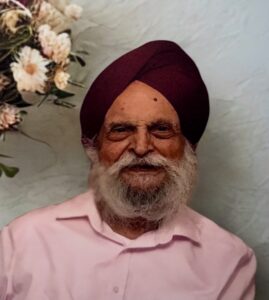
 Sardār Iqbal Singh Kumar jī
(September 1928 – October 2025)
Our beloved father and grandfather—who led a long, fulfilled, pious, and successful life—passed away in late October 2025. He was a man of noble ideals and gentle strength. He possessed a profound reverence and devotion for Gurbāṇī, Gurū Nanak Dev jī and for all the Gurū Sāhibān jī. Side by side with bringing up a family, pursuing a career, and his significant temporal achievements, he lived a life that was steeped in the spirit of Sikhī. Endowed with extraordinary fortitude, he remained ever active in sevā. He was an accomplished linguist, lawyer, poet, writer, and calligrapher, who served in civil service in both India and the United Kingdom for many years.
Early Life
Dār jī (short for ‘Sardār jī’—an honorific for Sikh gentlemen) was born on September 1928 in Garh Fateh Shah, a small village in District Lyallpur (now in Pakistan, and known as Faisalabad District), where his family lived for several years. The family later moved to Mandi Tandialawallah, a town about thirty miles away.
His father, Sardār Sunder Singh jī, was a trader in agricultural commodities like wheat and barley, as well as a ghī (clarified butter) merchant. Dār jī’s grandfather, Sardār Nihal Singh jī, was a thoughtful, religious man, and was referred to in the area as Bhagat Nihal Singh, since he spent his entire life in the pursuit of religious and charitable activities. His father in turn—Dār jī’s great-grandfather—Sardār Hem Singh jī, was a successful entrepreneur and a financier, who left a significant fortune that Bhagat Nihal Singh jī was able to rely upon in pursuit of his religious endeavors whilst bringing up a large family.
Sardār Sunder Singh jī used to import ghī from Assam and other parts of India and supply it to neighboring areas. Later, he began supplying ghī for the langar and parśād at Janam Asthān Gurdwara Nankana Sāhib jī, the birthplace of Srī Gurū Nanak Dev jī—around forty miles away.
Around 1941, Dār jī’s father decided to build a house closer to Nankana Sāhib. The Gurdwara Committee had gotten to know him well and suggested that the family come even closer, and so in 1943, he and Dār jī—barely fifteen at the time, built a house about a ten-minute walk from the holy Gurdwara. The family moved there soon after, and Dār jī used to go to the Gurdwara Sāhib at least once a day, sometimes two or even three times. He would later say how peaceful it was, how he used to feel the presence of Gurū Nanak Dev jī whenever he was there, and how this played an important role in shaping his worldview and his deep faith and reverence for Gurū jī. The family stayed there until 1947.
In 1945, Dār jī had joined Khalsa College, Lahore for a while, returning home intermittently. Then came the Partition of India and Pakistan on 15 August, 1947. This was a deeply formative event in his life, and the harrowing escape by him and his family from their home to Amritsar Sāhib left an indelible mark on his perspective and consciousness.
It was an extremely dangerous time. It became clear that if the family were to remain alive amidst the incredible violence that began even a few days before 15 August, they would have to leave immediately. Two very significant incidents occurred in the next few days.
The first incident related to the exceptionally dangerous environment around 15 August, when life had become utterly capricious. Dār jī later recalled that one of his closest friends warned him around 25 August that a large mob, consisting of hundreds, possibly of a thousand Muslim fanatics, was assembling nearby and intended to attack and kill all Sikhs in the area the next evening. The family was terrified and prayed vehemently to Gurū jī.
Then something remarkable happened. The next morning and afternoon, there was extraordinarily torrential rainfall—extremely heavy and extremely unusual for late August in that region. The same friend returned to say that the mob would not come that evening, but would return the next evening, and that all the Sikhs would be killed. This event had a deep and lasting effect on his faith and on his feeling that Gurū jī was with him always
The second event followed this. Dār jī’s granduncle, Sardār Gopal Singh jī, was a senior politician in Lahore. Immediately after the announcement of Partition, he had been able to arrange for a truck to come from the Indian side, via Amritsar Sāhib, to evacuate the family. At that time, Dār jī’s own father was in Assam, arranging ghī supplies, and Dār Jī, not yet nineteen, was therefore responsible for the family of seven younger siblings, being the eldest. There was extreme consternation as to how Dār jī’s family, and many uncles and aunts, as well as even more cousins and other relatives, could fit into one truck and make their way to Amritsar Sāhib, the nearest city on the Indian side, almost seventy miles away.
However, when the truck arrived, the driver saw Dār jī’s granduncle and embraced him warmly. They had spent time together in prison during the Quit India Movement. This recognition made a huge difference: the driver was willing to wait, take time, and ensure that everyone boarded safely, even bringing some essential household belongings.
Dār jī and the entire immediate and extended family were able to escape—except for one relative who happened to be out of town. That relative later tried to leave Pakistan by train, forgot something, returned to the house, and never came back. Dār jī often recounted how in the journey to Amritsar Sāhib, he saw literally hundreds of dead bodies, killed by the fanatics, littering the sides of the road
The family stayed in a refugee camp in Amritsar Sāhib for a few weeks. Then Dār jī’s father and grandfather decided that they should go to Delhi. They boarded a train, but it stopped in Jalandhar and was delayed for several hours. They got off the train and entered the city, which had been largely deserted by Muslim families who had migrated. They found a large, very spacious havelī (large mansion) completely unoccupied. Given the state of complete lawlessness and chaos, they literally just moved in there—and stayed there for eight years.
Dār jī then moved to Chandigarh and then Patiala. After completing B.A. and M.A. degrees in geography and languages, he began his civil service career in Punjab. Later he also studied law in India.
He was married in 1953 to my mother Sardārnī Gurcharan Kaur jī, an equally accomplished and extremely pious GurSikh lady. She was a dedicated educationalist, prize-winning musician with a graduate degree in sitār, and a remarkable kīrtanīā. My mother was a professor at the State College of Education in Patiala. Dār jī worked in the Excise and Taxation Office in Patiala until 1967. In September 1967, our family—Dār jī, my mother, myself (eleven), and my sister Sukhpal (six)—moved to England as opportunities opened up there; my mother had received what was then called a ‘voucher’ to come to England and teach there.
Life In England
Dār jī often described how moving to England was a second transition in his life, following the Partition. Although much less harrowing, and a completely different situation, it was unsettling, and he and my mother had to start life afresh. Nonetheless, he also emphasized that with his faith in Gurū jī and having gone through the Partition, this was not that overwhelming, and they began to settle in a very different world quickly. He got a job in the London headquarters of the UK post office—which was at that time part of the civil service, and my mother started teaching in a London school. He remained active in Sikh affairs in London, while maintaining his creative pursuits in writing and poetry.
Dār jī was among the founding members and the Senior Vice President of the Singh Sabha Gurdwara in the late 1960s. As part of the management, he laid the foundation stone of the Gurdwara Sāhib at Havelock Road (now named Gurū Nanak Road) in 1969—on the 500th Avatār Divas of Gurū Nanak Dev jī. His service and leadership there left a lasting imprint.
Quite early on after arriving England—within only three or four years—Dār Jī was invited to join Lincoln’s Inn, qualifying to practice law as a barrister. However, he did not take up what would have been a significant professional opportunity.
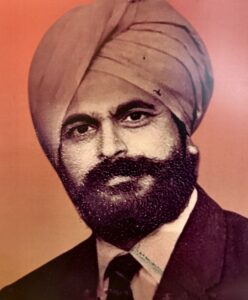
I later asked him why he had not taken it. He said that we were new in the country and still settling; my sister and I were still in school, my mother was teaching, and he felt that taking on such a demanding position would place too much pressure on the family. He chose instead to remain in the post office, so that he could support us properly, help with our education, and ensure we had the best opportunities.
This theme of family responsibility and sacrifice was very strong in him. He made sacrifices in his own career and personal advancement to support the family. He also gave up potential financial gains so that education could take priority.
Dār jī was deeply committed to ensuring that we received the best possible education. Before I started working, many people suggested that I take up employment immediately, but he was strongly opposed. Even more strikingly, after I completed my BSc and MSc at London University, I obtained a well-paid position at British Petroleum in the Corporate Planning Department, while also applying for a PhD. He and my mother were also very strongly supportive of my sister obtaining her degree in psychology and education from London University.
When I was accepted to Cambridge, many relatives in England felt I should keep the job and not go. But both my father and mother were strongly opposed to that view. He would say that higher education is never wasted. Despite the excellent salary and prospects, at his urging, I resigned after a few months and began my studies at Trinity College, Cambridge in January 1979.
Dār jī worked in the United Kingdom for many years, retiring from the post office in 1995. My mother also retired soon afterwards, and they both received love and care from my sister Sukhpal, her husband Harpeet, and their kids Gurleen, Govindpal, and Arjan. Upon retirement, he had even more time to engage in his pursuits of Gurbāṇī, kathā, kīrtan, Sikh community affairs, as well as reading and poetry.
Life in America
Dār jī was in the United States, staying with our family—myself, my wife Kiran, and our children—Prabhjote, Avneet, and Nankee—in Maryland from May 2019 onwards. It was an extraordinary blessing to see him and spend time with him, looking after him every day for these past six and a half years. As in London, he was surrounded by love, care, and deep family affection.
Here he was able to spend even more time in his creative pursuits: a gifted linguist, he had exceptional command over English, Punjabi, Urdu, and Persian. He was a very talented writer, poet, and photographer, with an exceptionally beautiful handwriting—each word reflecting artistry and depth.
For over eight decades, in America, Britain, and India—before and after the Partition—he remained steadfast in his daily recitation of Gurbāṇī, including Panj Bāṇīān dā Pāṭh—always with deep understanding and conviction of the presence of VāhiGurū jī within and around him. Listening to kathā and kīrtan was an integral part of his life. When Dār jī was with us in United States, his devotion, his harmony, and his attunement with VāhiGurū jī was striking and remarked on by all our family and friends.
I was blessed to often have the opportunity to discuss with him philosophical and theological issues, and I was amazed by his extraordinary devotion and understanding.
One day, about two years ago, we were talking about VāhiGurū jī’s presence, and I asked him how different people say different things: some say VāhiGurū exists, some say they do not know, some deny his existence. I asked him in Punjabi—”Dār Jī, VāhiGurū jī kithe ne?”— ‘where is VāhiGurū jī’?
He did not respond for a short while. I wondered whether, given his advanced age and Alzheimer’s, he had not heard or understood the question. I repeated it twice.
Then he looked at me and gave a two-word answer in Punjabi: “kithe nahīn?”—‘where is he not?’ As he was saying those two words, I almost had this incredible feeling, that he was, as it were, feeling immediately the presence of VāhiGurū jī. I was utterly mesmerized.

A few days later, we had another similar discussion. I said, “Dār jī, you had said VāhiGurū jī is everywhere, but we cannot see Him. Why don’t we see him?” Again, he did not respond at first. I asked him again. Then he gave a short, four-word reply, in Punjabi: “Je akhān hoṇ tān”—‘if you had the eyes.’—again, with the same look in his eyes.
This discussion, and there were many more like this, reflected the depth of his devotion—his sense that VāhiGurū jī was always present, always with him. This faith played a very important role during his final year. Despite fairly severe Alzheimer’s symptoms, he seemed remarkably free of pain and distress, unlike what is often associated with advanced stages of the illness.
His faith and rich life experiences also manifested in his ability to see even the most challenging situations in perspective, to let things go, and to have incredible calmness and equanimity. If there were contentious issues, or disagreements—whether with colleagues, friends, or even within the family—he never held grudges. We might get upset, but he would say, “Koī gal nahīn.”—‘That’s okay. Let it go.’
A Moment of Grace
There was a notable incident earlier in my father’s life—one that always struck him, and us, as almost miraculous—an event that quietly but powerfully deepened both his and my mother’s faith.
I was about four years old at the time. My father was studying in the evening for one of his examinations, seated at his desk in our home in Patiala. His feet rested only a few inches from an outside wall. At the base of that wall was a large opening, designed to allow water to drain when the concrete floors—washed daily—were cleaned.
He had been sitting there for some time when my mother, who was in an adjoining room, called out to him for help. He rose from his chair and stepped away—only moments before what followed.
Almost immediately, a large snake entered the house through that opening. Even now, decades later, I remember the scene vividly. The snake moved freely through the house, clearly visible to both my parents, and to me, despite my young age. In my memory, it seemed enormous, its presence deeply unsettling.
Had my father remained seated, with his feet so close to the opening, the likelihood of a snakebite was extremely high. A single strike could have changed everything. Whether he would have survived is something no one can say. Instead, he had moved—called away at precisely the right moment.
The snake continued to move through the house and went near, or possibly even into, the small room where we had Gurū Granth Sāhib jī’s prakāś. Throughout this frightening episode, I remember my father as remarkably calm and composed, entirely without panic. He took a sheet and a large stick, ready either to contain the snake or drive it out as necessary.
After some time, the snake left the house through the same opening by which it had entered. My father immediately sealed it. Outside, we could hear movement for a while longer. By the next morning, when he called friends to help investigate, the snake had shed its skin and disappeared.
The danger had passed. What remained was the quiet awareness of how close the moment had been—how narrowly catastrophe had been avoided. My father would often reflect on this incident in later years. I, too, carry a direct and vivid memory of it. To him, it was not mere chance. It was a moment of grace, one that strengthened his faith—and my mother’s—in VāhiGurū jī.
He would say, simply and with deep conviction, that when one places trust in Gurū jī, protection comes—often unseen, and often at the very last moment.
Faith Tested, Faith Strengthened
There was another incident, very different in nature and occurring many years later, yet equally extraordinary—one that my father would recall often, and one that again left a deep impression on all of us.
This took place in September 1965, during the war between India and Pakistan. By then, we had moved to another house in Patiala, about three miles from our earlier home. We had built a small room in the indoor veranda, where we had the prakāś of Gurū Granth Sāhib jī. As was his long-standing habit, my father would rise early each morning—usually around four or five o’clock—and go to that room.
The light switch for the room was located outside, just next to the door. On that particular morning, Dār jī woke as usual and went to turn on the light. As he later described—many times over the years—when he tried to switch it on, he felt an electric current and was unable to do so. He tried again a second time, and once more a third time. Each attempt failed. The light simply would not turn on.
He then stopped. Almost immediately afterward, there was loud knocking on the door. The night patrols were shouting urgently that Pakistani bomber aircrafts were in the airspace very nearby and that everyone needed to move out of their houses at once. This was a period of complete blackout, imposed so that aircrafts could not identify inhabited areas from the air. We were soon rushing toward small trenches and shelters nearby.
Within moments, we heard the planes flying overhead. Soon after, bombs were dropped. By the next morning, we learned that the bombs had fallen about three miles from our house in an uninhabited area.
It became chillingly clear what might have happened. Had my father succeeded in switching on the light, even briefly, in an otherwise pitch-dark area, that single point of illumination could easily have been visible from the air. The likelihood that the aircraft would have identified it as a target—and dropped bombs directly on our house or in the immediate neighborhood—was terrifyingly high. The devastation would have been unimaginable.
Instead, the light did not turn on.
My father always regarded this not as coincidence, but as protection. To him, the failure of that switch—at that precise moment—was no less significant than the narrowly avoided danger years earlier. This event, too, deepened his faith, my mother’s faith, and later my own, in VāhiGurū jī’s presence and guardianship.
These various incidents—from the chaos of Partition, from a potentially fatal snakebite, from the darkness of war—were very different in form, yet deeply connected in meaning. In one, totally unexpected torrential rain saved an entire family and a community; in another, Dār jī was called away moments before danger entered his home; in the third, a light refused to turn on when illumination itself would have been perilous.
In all these moments, danger was real and immediate. In each, protection came quietly, without drama, without spectacle. And in each, my father saw not randomness, but grace.
Together, these experiences shaped his understanding of faith—not as something abstract or distant, but as something lived, trusted, and reaffirmed through life itself. They reinforced his conviction that when one places trust in Gurū jī, help arrives—sometimes invisibly, sometimes at the very last instant, but always with purpose.
For him, faith was not weakened by these life threatening events. It was forged by it.
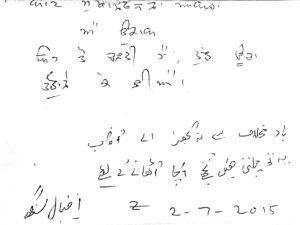
These events helped shape his broader outlook: take it easy, do your very best, think and plan carefully before acting, and above all, have faith in Gurū Nanak Dev jī. He believed deeply that VāhiGurū jī is always here.
He has now gone to his heavenly abode to join his beloved wife of sixty years, Sardārnī Gurcharan Kaur Kumar M.A., ME.D, who passed away in October 2013. Dār jī is lovingly remembered by his children, and six grandchildren.
Sardār Iqbal Singh jī was truly special. His vision, advice, and guidance were invaluable in shaping our lives. His vast knowledge, quiet confidence, and graceful demeanor inspired everyone around him. His life was a radiant example of intellectual and spiritual wisdom, unshakeable faith in Gurūs, hard work, inner strength, and a calm and thoughtful approach to life and its challenges, with čaṛhdī kalā at all times. This is the legacy he leaves behind for us and that will forever inspire us. May VāhiGurū jī bless his soul with eternal peace—apaṇe čaranā vič hameśā nivās bakaśaṇ—and may He give us the strength to follow in his noble footsteps.
In light of Dār jī’s lifelong reverence for Gurū Nanak, to conclude, I offer Dār jī’s poem ‘In Honor and Joy on SatGurū Nanak Dev jī’s Avatār Divas‘ in his own Gurmukhi calligraphy along with my translation of the poem into English.

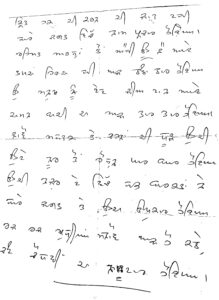
There is great joy in the whole world today at the Avatār
of our most revered and beloved SatGurū Nanak Dev jī.
VāhiGurū jī Himself manifested in the form of a human being;
the sinking ship that was India began to float again.
Today the Divine brother of Bebe Nankee came,
and the map of Sikhī began to be prepared.
All the beautiful flowers on earth are spreading happiness;
every leaf is blooming with joy.
SatGurū jī spoke against falsehood and the darkness of ignorance.
He lit the lamp of knowledge and showed the true path.
He took evil deeds to task and spoke on behalf of the oppressed,
revealing their blood in the delicacies served by Malik Bhago.
He broke the chains of discrimination
and struck down ego and pride.
He taught honest work and sharing with others;
the remembrance of Nām spread throughout the world.
He came with the most special blessings of VāhiGurū jī;
even the coldest hearts softened in His presence.
He came to give us true life, explaining the path of liberation;
he struck down evil deeds and taught us how to live according to Hukam.
Let us all bow to Him and partake of the dust of SatGurū jī’s feet;
the incredible light emanating from Him has lit the whole world.
In His Divine merciful gaze are all joys and blessings;
He has bestowed such kindness upon humanity.
Celebrate, celebrate with immense joy and happiness—
the most amazing, extraordinary Being has come.
_____
Manmohan Singh Kumar, PhD (Cantab)